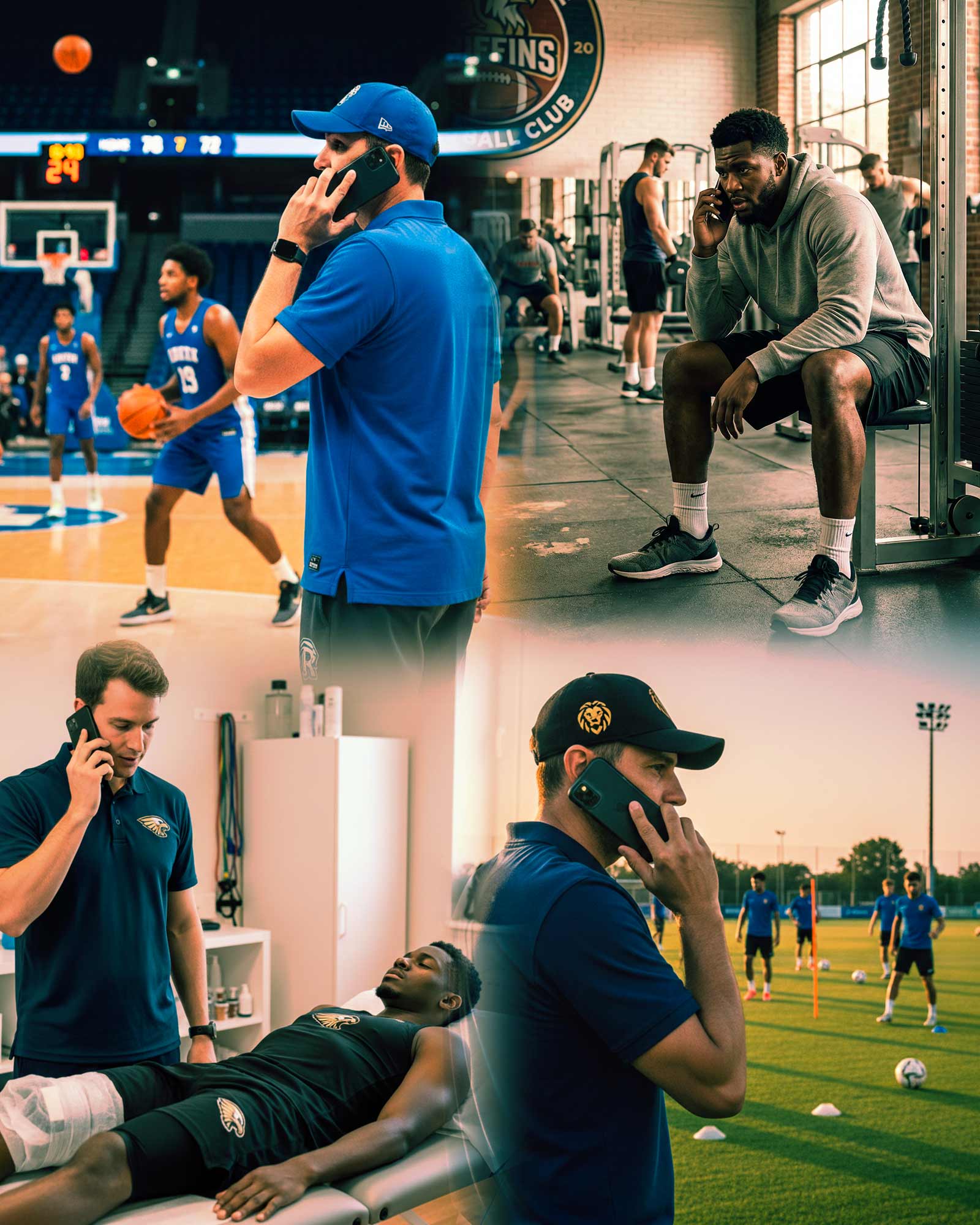
How Apollo’s Advanced ‘Voice-to-Text’ Technology Eliminates the Data Lag in Elite Sport
In elite sport, speed often makes the difference between winning and losing. This is a principle that applies not only to the performance of athletes in competition, but also to the way support staff operate behind the scenes. Informed decisions regarding training load, injury risk, performance readiness and athlete availability depend on immediate access to up-to-the-minute, detailed and accurate information, meaning that these decisions rely on vital athlete specific data being entered into the AMS as soon as it is determined. However, despite enormous investment in advanced athlete screening and tracking technology, one of the most important sources of this athlete specific data is often completely overlooked. For years, the ‘coaches’ eye’ was a crucial part of the overall athlete assessment process, however, more recently the observations, judgments, and subjective insights of expert practitioners have become constrained by an old problem: consistent recording and documentation takes a lot of time and effort. Here we look at how Apollo’s unique ‘Voice-to-Text’ technology speeds up data collection and preserves the insights that drive elite performance.
Staff Working in Elite Sport Don’t Have Time to Record High Quality Information
Fitness coaches finish a session and promise themselves that they’ll enter notes into the AMS later. Physiotherapists complete an assessment but must wait until the end of the day to write a summary. Doctors dictate injury updates into personal devices and then, when they eventually have time, must transfer them manually into the system. Coaches observe something tactically significant and talk about it amongst themselves on the touchline, but never formally record it, and the moment is lost forever. By the time information from each of these different sources reaches the AMS, hours, or even days, may have passed. Specific details fade, information quality declines, and critical insights that could make a world of difference never even make it into the permanent record.
Apollo solves this problem by allowing practitioners to capture information instantly, accurately, and effortlessly using its advanced Voice-to-Text technology. Instead of delaying documentation, staff can speak naturally and have their words transcribed directly into the platform in real time. The outcome is simple but transformative. Faster data entry, greater precision, and a complete, reliable performance record captured in the moment rather than reconstructed later.
The Hidden Cost of Delayed Data Entry
Elite teams invest heavily in tools that provide a mountain of information. GPS metrics, force plate outputs, wellness scores, nocturnal HRV….the list grows longer every year. But among all this objective data, we must remember that subjective observations from expert practitioners remain as relevant and insightful as any piece of technology. How an athlete moves during rehabilitation, how they respond emotionally to training, or how a coach interprets readiness or fatigue are insights that don’t just come from sensors, they come from the interpretations of highly experienced staff members.
The problem is that manual documentation becomes a burden. Staff are busy delivering sessions to athletes, these sessions quickly follow one after another, and suddenly immediate priorities have taken precedence over administrative tasks. In the real world, this means that documentation nearly always gets deferred, and this delay introduces three major risks. Firstly, a prolonged day working intensively with athletes means that staff are likely to be mentally fatigued when they are logging data. Memories are imperfect, and this can lead to a loss of accuracy. Even a few hours can blur important details, especially when staff have dozens of athletes to work with. Secondly, when notes are written later, terminology may vary, which creates a loss of consistency and makes longitudinal tracking and communication more difficult. Finally, some observations are never recorded at all and remain informal conversations instead of structured organizational knowledge. This results in a complete loss of information, and over time these data gaps weaken the effectiveness of the AMS. Human insights drive real decision-making, meaning that instead of serving as a complete source of understanding, the AMS suddenly becomes only a partial record.
Apollo Voice-to-Text removes the friction that causes these data gaps in the first place.
Eliminating Data Lag: From Delayed Entry to Immediate Insight
One of the most damaging patterns in any AMS is data lag. When there is a delay between observation and documentation, or when notes are entered hours later, important details can be lost, observations are simplified, and some notes are never even entered at all. Yes, practitioners may well have a significant quantity of objective measurements to rely on, but this only provides part of the picture. Without subjective observations from staff members to provide context and meaning to this objective data, decision-makers are having to operate on incomplete information, and this clearly undermines any criteria-based decision-making process.
Apollo Voice-to-Text eliminates this data lag entirely. Documentation happens immediately, and expert observations become recorded data instantly. The result? Decision-makers have access to the most current, accurate information possible, and the AMS becomes a real-time decision-making platform, rather than just a historical archive.
Voice Is the Fastest Interface
Speaking is the fastest and most natural way that humans communicate. Most people speak at 125 to 150 words per minute, which is far faster than typing on a mobile device or a laptop. In high-performance environments, where staff are constantly moving between fields, gyms, treatment rooms, and meeting spaces, voice input removes the barriers to documentation.
Apollo’s Voice-to-Text capability allows users to dictate notes directly into the system from their phone or any supported device. Observations are then immediately transformed into structured records, without any interruption to staff workflow. Powered by Nuance’s industry-leading speech recognition technology, Apollo accurately captures specialized terminology, medical language, and sport-specific vocabulary. Practitioners can speak naturally and trust that their meaning is preserved.
The result is not just faster documentation, it’s better documentation.
Breaking it Down: How Apollo Voice-to-Text Drives Effective Data Collection in Every Department
Sports Scientists: Capturing Context That Sensors Cannot
Sports scientists operate at the intersection of objective measurement and professional judgment. GPS metrics, heart rate data, and neuromuscular testing provide quantitative insights, but any sport scientist knows that similar numbers and outputs can be generated in a variety of different ways, meaning that interpretation is entirely dependent on context. Voice-activated workflow provides this context by allowing sports scientists to record crucial observations the moment they occur:
- “Lisa completed the session, but she showed visible fatigue during the final sprint block.”
- “John’s movement quality is noticeably poorer today despite his GPS output being normal. This needs further investigation.”
- “We modified the final drill today due to three players reporting hamstring tightness.”
Observations such as these provide context for trends, explain loading spikes or fatigue anomalies, and preserve important subtle details that would otherwise disappear. Most importantly, they ensure that insights are captured whilst they are fresh in the mind, with the result that objective datasets become immeasurably enhanced by in-the-moment expert interpretations.
Strength and Conditioning Coaches: Documenting Training in Real Time
S&C coaches operate in high octane, fast-paced environments, where stopping to type notes is completely impractical. Sessions involve constant movement, supervision, and adjustment. This is where Apollo Voice-to-Text comes into its own. Voice entry allows S&C coaches to record:
- Load adjustments.
- Athlete feedback.
- Technique observations.
- Compliance notes.
- Modifications due to fatigue or discomfort.
Instead of trying to reconstruct the session from memory hours afterwards, S&C coaches can simply speak their observations between sets or immediately after the session concludes. This preserves a complete picture of what is really happening in the weight room, rather than a vague and simplified version remembered later.
Technical and Tactical Coaches: Preserving Tactical Insight
Every single day, technical and tactical coaches observe moments in training that will influence selection, strategy, or individual player development. In the real world of elite sport, these observations nearly always remain unrecorded, which is entirely understandable because in the coaching moment, documentation feels of secondary importance. This means, however, that some of the most crucial, functional and relevant athlete specific performance data is lost forever. Apollo Voice-to-Text closes this gap by making data capture effortless:
- “Quick tactical note on Ethan. He’s stepping out to press without cover behind him, which is leaving gaps between the lines. We need him to hold his position unless the press trigger is clear.”
- “John’s off-the-ball movement in the final third is poor. He needs to be more explosive to create separation from defenders and create passing options.”
- “Samantha is not adjusting her position based on the ball location, especially in the final 15 minutes of the game. She needs to stay connected with the midfield unit to maintain compactness. We need to determine if this is a fitness issue or a lack of game understanding.”
These insights become searchable, shareable, and connected to performance data. Over time, they create a longitudinal record that supports progressive athlete development and ensures an integrated approach to the coaching process.
Physiotherapists: Accurate Injury and Treatment Documentation
For physiotherapists, precise documentation is essential. Injury assessments, treatment plans, and rehabilitation progress must be recorded accurately and consistently, a process which is dramatically accelerated by Apollo Voice-to-Text. Immediately after assessing an athlete, a physiotherapist can dictate:
- Subjective symptoms.
- Objective findings.
- Treatment performed.
- Athlete response.
- Rehabilitation progression.
Nuance-powered transcription ensures medical terminology is captured correctly, preserving clinical precision. This eliminates the need for handwritten notes, later transcription, or memory-based reconstruction. The assessment becomes part of the permanent medical record instantly.
Team Doctors: Clinical-Grade Documentation Without Delay
Team physicians operate under significant time pressures, balancing clinical responsibilities with team schedules. Apollo’s voice-activated workflow allows doctors to document medical evaluations quickly and accurately. Clinical notes, diagnoses, recommendations, prescriptions and follow-up instructions can be dictated directly into the Apollo platform, ensuring medical records remain complete and compliant. This improves continuity of care, communication between medical staff, decision-making concerning athletes and, importantly, legal and regulatory documentation standards. This form of immediate documentation reduces risk and strengthens organizational accountability.
Performance Analysts: Capturing Observations During Review
In recent years, perhaps the greatest growth in support staff has been in performance analysis. Performance analysts spend hours reviewing video and competition data, identifying patterns that influence tactical planning and inform athlete development. The work can be long and arduous, and when a coach needs a selection of video clips for a presentation, they plan to deliver the next morning, can be performed under significant time pressure.
Apollo Voice-to-Text provides invaluable support to analysts, as it enables them to document the insights they see whilst they are actually reviewing the footage, thereby eliminating any interruptions to their workflow. Instead of pausing to type, the analyst can vocalize their observations as they watch the footage. These insights are instantly transcribed and integrated onto the Apollo platform, creating structured and accessible data points that connect directly to the individual performance profiles of each athlete.
Front Office and Administrative Staff: Reducing Operational Friction
Administrative staff are the glue that holds every sports team together. They manage logistics, compliance, scheduling, and communication throughout the organization. But what happens when the travel company emails to say that today’s flight time has had to be changed due to the weather? Or the Head Coach wants the team to arrive to the game in the red polo shirt instead of the usual blue one? Or the parking location for the athletes going to the community event has changed?
Apollo Voice-to-Text simplifies the process of documenting operational updates, travel notes, and every other administrative action. This ensures that organizational records remain complete without adding more burden onto staff, and more importantly, that communication between departments is seamless because every new piece of information is entered into the system immediately.
Athletes: Capturing Subjective Feedback Without Barriers
Every performance decision should have one person at its center: the athlete. We sometimes overlook the fact that athletes themselves are critical contributors to performance data. Their interpretations of fatigue, soreness, readiness, and recovery provide insights that simply cannot be measured objectively. Athletes are notoriously non-compliant with providing useful feedback, however, voice-based input increases compliance by making reporting easier and faster. Apollo Voice-to-Text allows athletes to quickly report their perception of recovery status, sleep quality, wellness, training readiness and RPE feedback. When reporting takes seconds instead of minutes, consistency improves dramatically, and an enormous data gap is closed.
Not Just Another Generic Voice Tool: Why Apollo Voice-to-Text Makes the Difference
1) Improved Data Integrity Through Precision
For a voice activated workflow to be of any value, accurate transcription is essential. Generic voice-to-text tools often struggle with specialized terminology, abbreviations, and names common in elite sport and medicine. Apollo’s integration with Nuance technology ensures high transcription accuracy, even with complex clinical and performance language.
This preserves meaning and reduces the need for corrections, ensuring documentation remains efficient and reliable.
Precision builds trust in the system, and trust drives adoption from practitioners.
2) Reducing Administrative Burden and Cognitive Load
Administrative work is often the hidden cost in performance operations. Every minute spent typing notes is a minute not spent coaching, treating, or analyzing. Apollo Voice-to-Text dramatically reduces this burden. Staff can document naturally, without interrupting their primary responsibilities. This reduces additional workload, improves efficiency, and allows practitioners to focus on athlete performance rather than data entry. This way, documentation becomes integrated into the daily workflow, rather than separated from it.
3) Building a Complete Performance Record
Objective data tells part of the story. Subjective insight tells the rest. Apollo Voice-to-Text ensures both are captured seamlessly, creating a complete and reliable performance record. Over time, this improves decision-making, injury prevention, athlete development, and organizational efficiency. Every observation becomes accessible, every insight becomes usable, and nothing is ever lost.
The Future of Athlete Management Is Frictionless
Technology should accelerate performance operations, not slow them down. When documentation becomes effortless, staff compliance rises, which means that data quality improves, and as a result decision-making becomes faster and better informed. Apollo’s voice-activated workflow transforms the AMS from being a system that staff update later into a system they interact with constantly. By enabling rapid, accurate, real-time documentation powered by industry-leading speech recognition, Apollo eliminates data lag and preserves the insights that drive elite performance.
Written by Adrian Lamb, Apollo Sports Scientist
To learn more about how Apollo Voice-to-Text can make a difference to you email info@apollov2.com.